


Building Painting in Malaysia: How the Right Contractor Protects Your Property
For a condominium management committee, commercial property owner or facilities manager, repainting a building is rarely just a cosmetic exercise. A sound coating system helps protect suitable exterior surfaces from weathering, while poor preparation, unresolved moisture problems and unsuitable materials can bring defects back long before the next planned maintenance cycle. When evaluating building painting in Malaysia, the question is therefore not simply who can provide the lowest quotation. It is who can assess the building accurately, specify an appropriate system and demonstrate that the work has been completed as agreed.
This guide explains how the right painting contractor influences coating service life, what property managers should look for in a technical proposal and how to compare two seemingly similar quotations. It focuses on condominiums, office buildings, commercial premises and other managed properties, rather than routine interior house repainting.
Why Building Painting Matters for Long-Term Property Maintenance
Malaysia’s heat, rainfall, humidity and biological growth create demanding conditions for exposed building surfaces. Over time, sunlight can affect colour retention, rain can exploit existing defects, and algae may develop on persistently damp elevations. A suitable coating can help resist these exposures, but it cannot compensate for water entering through defective joints, failed waterproofing or significant substrate damage.
That distinction matters when discussing a building’s longevity. Painting does not extend the structural design life of a building by itself. Instead, correctly specified and maintained coatings can help preserve surface condition, reduce avoidable recoating and support a more predictable maintenance programme. Structural cracks, spalling concrete, reinforcement corrosion and active water ingress may require investigation and repairs outside a decorative painting contract.
For owners and management bodies, the financial impact comes from the entire project cycle: investigation, access equipment, preparation, repairs, painting, inspection and subsequent maintenance. A low initial rate may offer poor value if essential work is excluded and the same elevation needs attention again soon afterwards.
Start with the Façade Condition, Not a Paint Brand
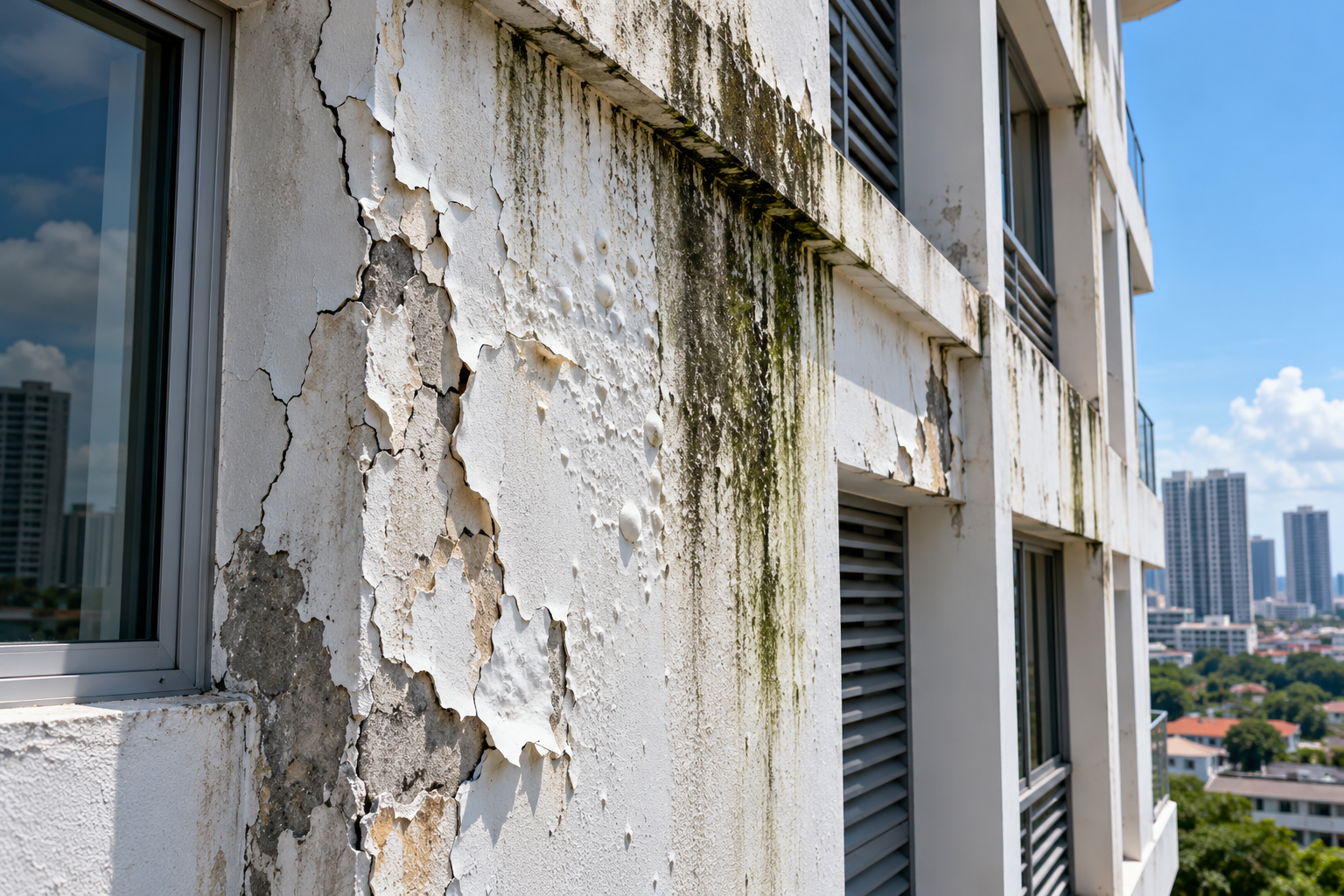
Before asking contractors to price a repaint, establish what is actually happening to the building envelope. A contractor should distinguish normal coating ageing from defects that need separate diagnosis. Otherwise, fresh paint may conceal a problem temporarily without resolving its cause.
| Observed condition | What it may indicate | What to clarify before repainting |
|---|---|---|
| Chalking or faded paint | Weathering of the existing coating | Surface soundness, cleaning method and compatible recoating system |
| Peeling or blistering | Loss of adhesion, trapped moisture or incompatible layers | Extent of removal, moisture source and substrate preparation |
| Algae or dark staining | Persistent moisture and biological growth | Cleaning, treatment, drainage and recurring wet areas |
| Hairline surface cracks | Movement or deterioration in render or coating | Crack classification and suitability of the proposed repair system |
| Wide or progressing cracks, spalling or exposed reinforcement | Potential underlying building defects | Assessment by an appropriately qualified professional before coating work |
| Recurring internal damp patches | Possible water ingress through the envelope or another source | Leak investigation and remedial scope before decorative finishing |
For example, a wall that repeatedly blisters after rain needs more than a stronger topcoat. The contractor should investigate whether the source is a failed joint, defective waterproofing, damp substrate or another condition. Where specialist waterproofing is required, LNL’s guide to hiring a waterproofing specialist in Malaysia explains the separate considerations involved.
How Coating Specification Affects Durability
Good contractors do not select materials by brand reputation alone. They consider the substrate, condition of existing paint, exposure, intended finish and manufacturer’s system requirements. They should also explain why each layer is necessary.
Substrate and existing-coating compatibility
Concrete, rendered masonry, previously painted metal and other substrates do not necessarily require the same primer or topcoat. Even on one building, different elevations or architectural features may need different preparation and materials. The proposed system must account for soundness, contamination, moisture and compatibility with coatings that remain in place.
Performance requirements, not marketing labels
For exterior walls, useful specification criteria may include weather resistance, colour retention, water resistance and vapour permeability where appropriate. Crack-bridging or elastomeric properties may be relevant to particular non-structural surface conditions, but they should not be presented as a remedy for structural movement or active leaks. Anti-fungal or anti-algal properties can support maintenance; they do not eliminate the conditions that encourage growth.
Ask for the proposed product names, technical data sheets, recommended primers, number of coats and applicable application conditions. Product selection should follow the manufacturer’s published guidance and a project-specific assessment. For general coating terminology and good-practice resources, consult the Painting and Decorating Contractors of America (PCA); product-specific decisions should rely on the relevant manufacturer’s technical documentation.
Genuine materials and controlled substitutions
A detailed proposal should identify the intended coating products rather than promise only a ‘premium paint’. If the contractor proposes a substitute, the owner or appointed consultant should review its compatibility and specified performance before approving the change. LNL states that it emphasises genuine products from established coating manufacturers and accredited suppliers; the project proposal should make those commitments verifiable through named materials and records.
Surface Preparation: The Work That Determines Whether the Finish Lasts
Painting quality depends heavily on what happens before the first finish coat. Contractors may need to remove loose material, clean contaminants, treat biological growth, repair appropriate non-structural defects and prepare a sound surface for the specified system. However, the correct sequence depends on the condition of the substrate and the manufacturer’s instructions.
Rather than accept a quotation that says ‘surface preparation included’, ask what the contractor will actually do. Will it remove all unsound coating or only scrape visibly loose patches? How will it identify and treat damp areas? Which repairs are included, and which require separate approval? How will the team confirm that cleaned surfaces are ready for priming?
Where the condition is uncertain, a sample area or trial application can help the parties agree on preparation, finish and inspection criteria before work expands across the façade. This is especially useful for occupied buildings with extensive elevations or several existing coating layers.
LNL’s separate article on the professional painting service process provides broader process context. For this project, the more important question is whether the agreed preparation is documented and checked before it is covered by subsequent coats.
High-Rise Building Painting Requires a Workable Access and Safety Plan
On a high-rise condominium or office tower, the coating specification is only part of the challenge. Contractors must also reach the work safely, protect occupants and manage access around entrances, balconies, vehicles and shared facilities.
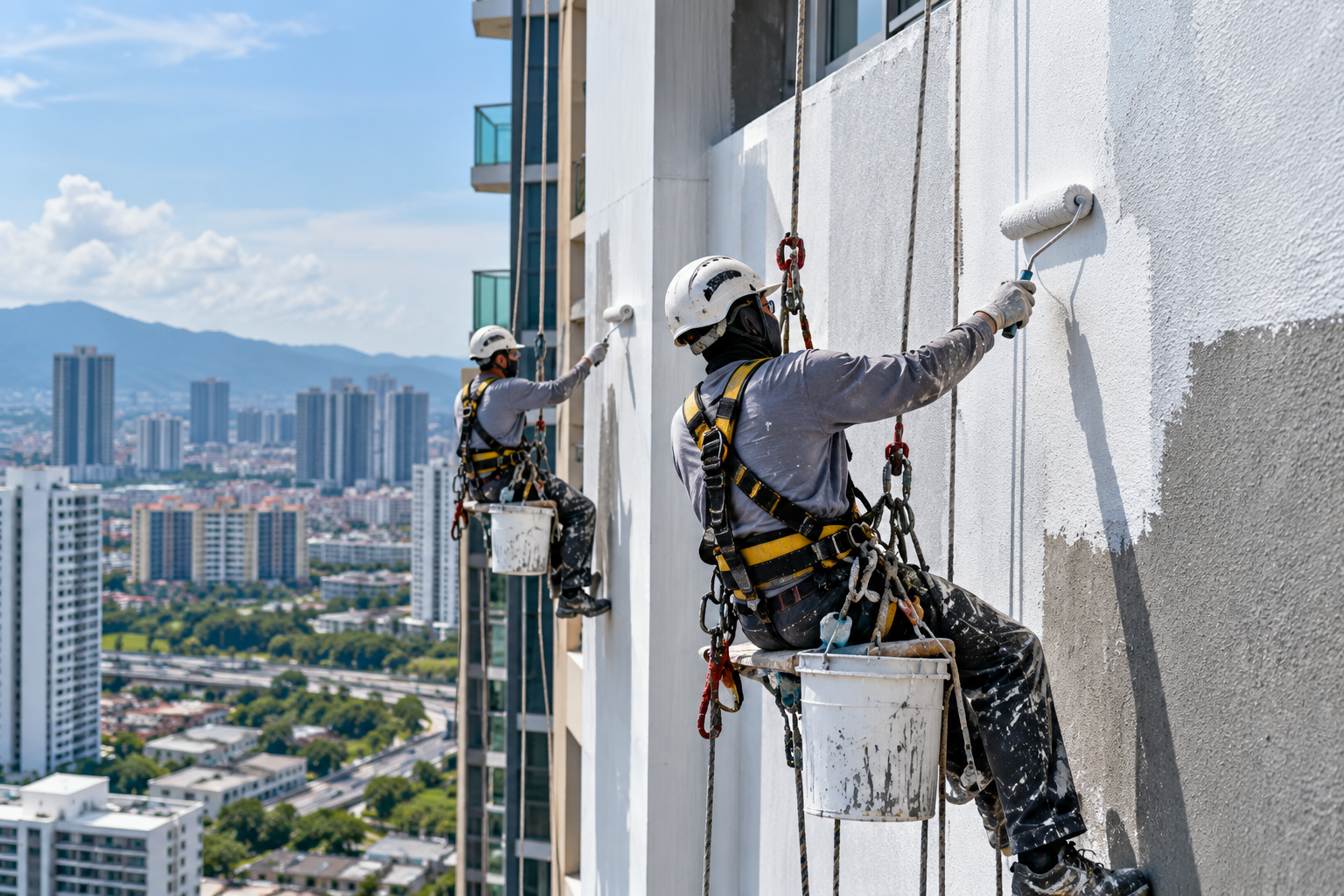
Depending on the building, access may involve scaffolding, mobile elevated work platforms or rope-access techniques. The appropriate method depends on site conditions, the work scope and competent assessment; rope access is not automatically the best solution for every façade. Ask the contractor to explain its access strategy, workforce competence, rescue arrangements, exclusion zones and coordination with building management.
Weather planning is equally important. Rain, strong winds and unsuitable substrate conditions can disrupt external works, while coating manufacturers specify limits for application and drying or curing. A credible programme allows for these constraints rather than assuming every elevation can be painted continuously.
For Malaysian workplace safety guidance, owners and contractors can consult the Department of Occupational Safety and Health (DOSH). The precise obligations and required controls depend on the activities and site; a generic statement that a team is ‘certified’ is not a substitute for reviewing the actual work plan.
Compare Building Painting Quotations by Scope, Not Just Price
Two contractors can quote for the same building yet propose substantially different work. The following example is illustrative; it does not describe actual LNL quotations or verified project prices.
| Comparison point | Contractor A: Basic repaint | Contractor B: Defined maintenance scope | Why it matters |
|---|---|---|---|
| Initial inspection | Visual estimate of paintable area | Documented condition survey with defect categories | Reduces ambiguity about what needs repair |
| Surface preparation | ‘Clean and scrape as required’ | Specified cleaning, removal and acceptance criteria | Makes preparation easier to verify |
| Moisture-related defects | Excluded without explanation | Identified separately for investigation or specialist repair | Avoids painting over unresolved problems |
| Coating materials | Generic exterior paint description | Named primer and finish products with data sheets | Supports compatibility and substitution control |
| High-rise access | Lump-sum allowance | Defined access method, protection and site coordination | Clarifies operational and safety responsibilities |
| Quality checks | Final visual walkthrough | Agreed stage inspections, defect records and handover | Helps identify problems before concealment |
| Aftercare | General verbal assurance | Written defects procedure and maintenance advice | Clarifies what happens after completion |
Contractor B’s proposal is more transparent, but that does not automatically make it the better purchase. The owner should confirm that the additional tasks are necessary, that both bidders price the same quantities and that exclusions are understood. A well-defined, appropriately scoped quotation is more useful than either an unexplained premium or an unusually low lump sum.
What Drives Building Painting Costs in Malaysia?
Building painting costs vary widely because the visible area is only one component of the work. A condominium façade with difficult access and extensive repairs cannot be priced reliably using a residential room-painting rate.
| Cost driver | Questions for the project team |
|---|---|
| Measured work area | Which walls, soffits, architectural details and exclusions are included? |
| Existing condition | How much defective paint, render or sealant needs attention? |
| Access and protection | What equipment, safety controls and occupant protection are required? |
| Coating system | Which primer, intermediate and finish coats are specified? |
| Building operations | Are restricted working hours, phased access or shutdowns necessary? |
| Inspection and handover | What records, testing where appropriate, touch-ups and close-out documents are included? |
Request a schedule of quantities or sufficiently detailed breakdown, clearly identified provisional items and a process for approving variations. Where repairs cannot be quantified before access is installed, agree how they will be measured, priced and authorised. This is more dependable than treating an indicative per-square-foot rate as a fixed project budget.
How to Evaluate Long-Term Value Across Repainting Cycles
For a managed property, the relevant question is not only ‘How much will we pay this year?’ but also ‘What work are we likely to repeat, and what could interrupt building operations?’ A useful evaluation considers the initial contract, expected inspection needs, repair exposure, access costs and the consequences of premature coating failure.
Imagine two proposals for the same façade. The first has a lower initial price but leaves preparation standards and moisture defects undefined. The second costs more because it includes targeted defect investigation, clearly specified preparation and documented quality checks. If the second scope addresses real risks, it may reduce the likelihood of unplanned remedial work. Yet no contractor can credibly promise a universal repainting interval without considering site exposure, existing conditions, coating system and maintenance.
Property managers should therefore compare assumptions, not invent savings projections. A simple lifecycle register can record the treated elevation, product system, completion date, observed defects, inspections and repair history. Over time, those records provide a better basis for budgeting and future tender decisions.
Quality Assurance and Handover: What Should the Owner Receive?
Project oversight should continue after the quotation is signed. Before work begins, agree on sample finishes, inspection points, communication responsibilities and how the contractor will report unexpected defects. During the works, record relevant substrate repairs and stage approvals, particularly where later coats would conceal preparation.
At handover, request the approved material schedule, available product data, a record of significant variations, outstanding defect items, care instructions and any written warranty terms actually offered. The warranty should identify its coverage, exclusions, duration and claim procedure; do not assume that every coating system or contractor provides the same protection.
For JMBs, MCs and facility teams, this documentation helps subsequent managers understand what was applied and where. It also makes future maintenance discussions more objective.
Why LNL Paints Is Relevant to Complex Building Repainting Projects
LNL Integrated Construction, established in 2003, positions itself as a specialist painting and façade repair contractor serving residential, commercial and industrial properties. Its stated capabilities span exterior and interior painting, non-structural façade treatment, waterproofing, protective coatings and high-rise rope-access work. This breadth can be useful when a project involves more than a straightforward change of colour.
LNL also describes a structured approach covering site inspection, tendering, mobilisation, monitoring, handover and post-project support. For prospective clients, the practical next step is to ask how those stages will apply to the particular building: who will inspect the elevations, which defects fall within scope, how access will be managed and what records will be supplied.
When comparing specialist providers, LNL’s article on what distinguishes a painting specialist in Malaysia offers further context. Facilities with separate industrial requirements may also find its factory painting guide useful.
Frequently Asked Questions
Should a JMB or MC appoint an independent consultant for a major façade repainting project?
For a large or technically complex project, independent advice can help define the scope, assess significant defects and review proposals. Whether to appoint a consultant depends on the building’s condition, project value and management’s available expertise. Where structural or serious water-ingress defects are suspected, obtain advice from appropriately qualified professionals rather than relying on a painting quotation alone.
Can a condominium repaint only the elevations that look weathered?
Phased repainting may be practical, particularly where exposure differs between elevations. However, the management team should assess coating compatibility, colour consistency, access costs and whether untreated areas are approaching the end of their useful service life. A condition-based plan can help avoid unnecessary repeat mobilisation.
Who should approve additional façade repairs discovered after access equipment is installed?
The contract should name the person authorised to approve variations on the owner’s behalf. Contractors should document the defect, proposed remedy, price and programme impact before proceeding, except where immediate safety measures are necessary. This avoids disputes over unapproved work and helps preserve an auditable project record.
What records should a building manager retain for the next repainting cycle?
Keep the approved scope, elevation drawings or marked-up areas, product names and colours, technical data sheets, relevant inspection and repair records, variation approvals, completion date and warranty documents where provided. These records make it easier to identify recurring defects and compare future coating proposals.
Plan a Building Painting Project with LNL Paints
Whether you manage a condominium, commercial property or high-rise building, a successful repaint starts with a clear understanding of the façade’s condition and the work required. Discuss your building’s exposure, access constraints, existing defects and maintenance objectives with LNL Paints before finalising a scope of work.
Contact LNL Paints to discuss your building painting requirements.
Disclaimer Statement
We hope you found this article informative. Our content is intended for general informational purposes only and does not constitute advice or necessarily reflect the full range of services offered by LNL Integrated Construction Sdn. Bhd.
Readers are advised to consult with a qualified industry professional and contact our experts for recommendations specific to their individual project needs. While we strive for accuracy and completeness in our blog posts, we cannot guarantee they are error-free. LNL Integrated Construction Sdn. Bhd. assumes no responsibility for any errors or omissions.