


Is Floor Coating in Malaysia Worth the Investment? A Guide for Warehouses and Factories
Floor coating can be a sensible investment for a Malaysian warehouse or factory, but not every concrete floor needs an epoxy or polyurethane finish. The decision depends on what the floor must withstand, what is already wrong with the concrete, and how much disruption the business can tolerate during installation.
A warehouse with persistent concrete dusting may benefit from a protective surface that is easier to clean. A production area exposed to chemical splashes may need a carefully specified resin system. On the other hand, a sound, low-traffic storage floor may not justify an expensive high-build coating. The key question is not simply whether floor coating in Malaysia is worth the price; it is whether a particular system solves a measurable operational problem.
This guide explains where floor coatings deliver value, when they may be unnecessary, how epoxy and polyurethane options differ, and what warehouse and factory managers should check before approving a quotation.
What Does Industrial Floor Coating Actually Do?
Industrial floor coatings form a protective, functional layer over a properly prepared substrate, usually concrete. Depending on the system, they can help control surface dusting, improve cleanability, provide specified resistance to chemicals or abrasion, and create visible walkways or work zones. Some systems incorporate texture to achieve an appropriate level of slip resistance.
However, a coating is not a structural repair. It cannot increase the load-bearing capacity of an inadequate concrete slab, correct severe settlement, or permanently conceal active cracks. Those problems require investigation and, where appropriate, engineering or concrete-repair work before coating begins.
For facilities comparing service providers, LNL Integrated Construction describes professional floor coating and related industrial finishing services among its construction and maintenance offerings. A site-specific assessment remains necessary to determine which system, if any, is suitable.
When Is Floor Coating Worth the Investment?
The strongest business case usually comes from a defined problem rather than appearance alone. Consider how the existing floor affects cleaning, material handling, production, safety management and maintenance.
| Facility condition | Potential value of coating | What to verify first |
|---|---|---|
| Concrete dust transfers onto stored goods or equipment | A suitable surface treatment may reduce dust generation and simplify cleaning | Whether the concrete is sound enough for coating or needs repair |
| Routine oil or chemical splashes | A compatible system may protect the surface and make spill response easier | Actual chemicals, concentrations, contact time and cleaning methods |
| Frequent forklift and pallet-jack movement | A properly specified finish may improve surface wear performance and marking visibility | Wheel type, point loading, turning zones, joints and existing concrete condition |
| Frequent washdowns or hygiene-sensitive processes | A suitable seamless system may support an easier-to-clean surface | Water temperature, detergents, drainage, falls and required hygiene controls |
| Sound concrete with light traffic and no recurring floor problem | Limited additional value from a premium resin system | Whether a simpler surface treatment or maintenance programme would suffice |
These are suitability examples, not promises of performance. The coating build-up, product data, installation quality and operating conditions all influence the outcome.
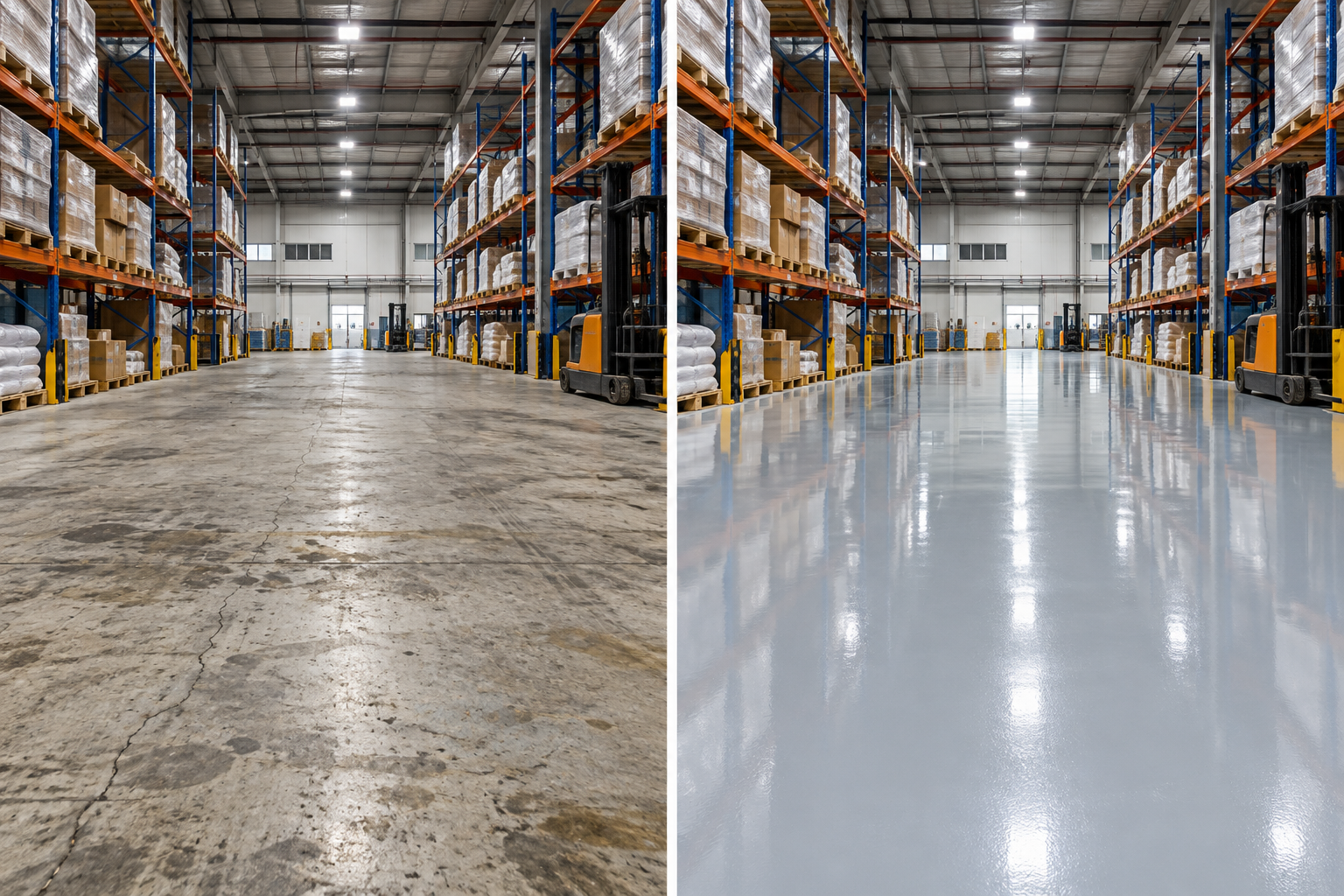
Epoxy vs Polyurethane Floor Coating: Which Fits Your Facility?
Epoxy and polyurethane are broad material families, not single products with identical properties. A thin roller-applied epoxy coating, a self-levelling epoxy system and a heavy-duty polyurethane-cementitious floor can behave very differently. Buyers should compare complete systems, including primer, thickness, finish and preparation requirements, rather than relying on the resin name alone.
| System family | Potential strengths | Important limitations or checks | Typical consideration |
|---|---|---|---|
| Epoxy coating | Can provide a durable, cleanable finish and resistance to selected chemicals | Performance depends on formulation and thickness; conventional epoxies may discolour under UV exposure | Indoor storage, workshops and production spaces with compatible service conditions |
| Polyurethane coating | Certain formulations offer good abrasion performance, flexibility or improved UV colour stability | Not every PU product is suitable for hot washdowns, heavy chemicals or outdoor use | Areas needing particular finish or exposure characteristics |
| Polyurethane-cementitious system | Specialised systems may suit demanding thermal, wet-processing or chemical environments | Requires correct system design, substrate preparation and installation conditions | Selected food-processing and industrial wet areas, subject to specification |
| Concrete densifier or sealer | May offer a simpler approach to dust control or surface maintenance | Does not necessarily provide the same chemical containment or seamless finish as resin flooring | Lower-demand floors where a full resin system may be excessive |
For an overview of available technologies, see Sika Malaysia’s flooring systems information and Jotun’s industrial coating resources. These are external technical references, not statements that LNL uses or endorses any particular manufacturer’s system. Always check the exact product technical data sheet and chemical-resistance information before specifying a coating.
Five Site Conditions That Determine Whether a Coating Will Work
1. Concrete strength, contamination and previous repairs
New paint cannot compensate for weak or contaminated concrete. An assessment should identify dusting, laitance, oil penetration, loose patches, previous coatings, joint damage and cracks. Surface preparation may involve grinding or another method selected to achieve the profile and cleanliness required by the chosen system. Repair methods must be compatible with the coating and the movement expected at joints.
2. Moisture and the source of dampness
Malaysia’s humid environment makes moisture management important, but ambient humidity is only one variable. Moisture moving through a slab, water ingress and an unsuitable substrate condition can compromise adhesion or cause blistering. Ask what moisture tests the contractor proposes, where readings will be taken and how the results will be compared with the coating manufacturer’s requirements. A surface that looks dry is not necessarily ready for coating.
3. Traffic, wheels and concentrated loads
Forklifts create different stresses from foot traffic. Hard wheels, turning movements, loading-bay transitions and repeated impacts can damage a coating even when the underlying slab remains structurally sound. Map the busiest routes and turning points. Heavy racks and machines also require a separate check of slab and foundation capacity; coating selection does not replace that assessment.
4. Chemical exposure and cleaning practices
Do not accept a generic claim that a floor is “chemical-resistant”. Provide the contractor with a list of chemicals, concentrations, spill durations and cleaning agents. Some systems resist occasional splashes but not continuous immersion or prolonged exposure. Hot water, steam cleaning and aggressive detergents can also change the specification.
5. Slip resistance, drainage and work-zone markings
A glossy surface is not automatically appropriate for a wet or oily process area. Slip resistance must reflect the real operating conditions, footwear and cleaning regime. More texture may improve traction in some situations but can also make cleaning harder. The right balance is site-specific. Markings for pedestrian routes and forklift lanes should fit the facility’s broader traffic-management arrangements rather than serve as a substitute for them.
How Much Does Floor Coating Cost in Malaysia?
There is no reliable single installed price for all industrial floor coating projects. Online prices often refer to different coating thicknesses, substrate conditions, project sizes and inclusions. A low quoted rate can be misleading if it excludes concrete repairs, moisture treatment, surface preparation, line marking or the downtime needed for curing.
Instead of applying a generic RM-per-square-foot figure to a factory budget, request a measured quotation with the proposed system build-up and a clearly defined scope. This is particularly important when comparing a thin coating with a high-build resin floor: they are not equivalent products.
| Cost driver | Why it changes the quote | Question for the contractor |
|---|---|---|
| Existing floor condition | Crack repair, removal of old finishes and substrate treatment add labour and materials | Which repairs are included, excluded or provisional? |
| System thickness and number of layers | Material consumption and installation steps differ significantly | What is the specified nominal dry-film or system thickness? |
| Area, layout and access | Small rooms, obstructions and staged works can reduce productivity | Is the price based on a measured area and agreed work zones? |
| Operating restrictions | Night shifts, phased handovers and accelerated programmes affect cost | When can pedestrians, forklifts and production return? |
| Performance requirements | Anti-slip aggregates, chemical resistance and line markings can require additional components | Which performance requirements are supported by product documentation? |
Calculate Value Using Total Cost, Not Just Installation Price
The most useful comparison is between realistic options over a chosen evaluation period. Consider the initial work, planned cleaning, expected repairs, possible recoating and operational disruption. Avoid assuming a universal lifespan or a guaranteed return on investment.
Illustrative decision method: A warehouse manager comparing two options can calculate:
Estimated ownership cost = initial preparation and installation + scheduled maintenance + anticipated repairs or recoating + identifiable operational disruption.
For an uncoated floor, include current dust-control and patch-repair costs. For a proposed coating, include cleaning requirements, inspection intervals and any future refurbishment allowance. Where the business cannot quantify a cost confidently, record it as an uncertainty rather than inventing a saving.
Ask the contractor to explain the assumptions behind expected service life. Wheel loads, UV exposure, cleaning chemicals, moisture and maintenance practices can all shorten or extend performance. An appropriate system may provide good value, but a poorly matched one may fail early and increase the overall cost.
Two Practical Warehouse and Factory Scenarios
Scenario A: Dusting in a dry-goods warehouse
Imagine a warehouse where concrete dust repeatedly settles on cartons and equipment. The manager first checks whether the slab is sound, whether moisture is present and whether forklift traffic is concentrated in specific aisles. If the concrete is suitable, a correctly specified surface treatment could reduce dusting and improve cleaning. The manager should compare a coating with a simpler densifier or sealer rather than assume that the most expensive resin floor is necessary.
Scenario B: A factory washdown area
Now consider a factory where floors encounter regular washdowns, cleaning chemicals and wet foot traffic. The decision is more demanding. The specification must address drainage, slip resistance, water temperature, chemical exposure, substrate condition and curing time. A basic decorative epoxy finish may not meet the operating requirements. A specialised system could be justified, but only after the actual exposure conditions are confirmed.
These are illustrative scenarios, not documented LNL Paints projects or claims of measured savings.
Installation Downtime: The Cost Many Buyers Overlook
Factories and warehouses often need to keep operating while floor work takes place. Yet the installation programme includes more than the time needed to apply the final coat. Preparation, repairs, primer application, intercoat intervals and curing all affect when the floor can return to service.
Ask for separate dates or time windows for pedestrian access, light wheeled traffic, forklifts and chemical exposure. Those conditions may have different curing requirements. A floor that can be walked on is not necessarily ready for loaded forklifts or aggressive cleaning.
Phased installation can reduce disruption, but it creates its own practical challenges: protecting completed areas, keeping dust away from adjacent work zones and maintaining safe traffic routes. The project plan should explain how these interfaces will be managed.
How to Compare Two Floor Coating Quotations Fairly
Suppose Contractor A offers a lower total price but lists only “epoxy coating, two coats”. Contractor B quotes more but specifies substrate inspection, mechanical preparation, a named primer, a stated system thickness, crack-repair allowances, curing restrictions and handover checks. The second quotation is easier to assess because it explains what the buyer is paying for. That does not automatically make Contractor B better; it shows why scope transparency matters.
Before choosing either proposal, compare these items on the same basis:
- Substrate assessment: condition survey, moisture evaluation and contamination checks.
- Preparation: cleaning, grinding or other specified profiling and treatment of existing finishes.
- System specification: manufacturer, product names, primer, coats, thickness and finish.
- Performance fit: documented suitability for traffic, chemicals, cleaning and slip-resistance requirements.
- Scope boundaries: joints, cracks, floor repairs, line markings, edges and exclusions.
- Programme: area handover, application sequence, curing restrictions and return-to-service times.
- Quality control and aftercare: inspection points, agreed acceptance criteria, maintenance instructions and warranty limitations.
Relevant contractor experience is also worth examining. LNL’s project portfolio provides a starting point for reviewing its broader work; ask the team for industrial flooring examples that closely match your facility and for details that can be verified.
When Should You Avoid or Postpone Floor Coating?
Sometimes the best decision is to delay the coating work. Investigate active water ingress, substantial cracking, slab movement, widespread contamination or an uncertain concrete condition first. If the floor will soon be altered for new equipment or drainage, coating the entire area beforehand may create avoidable rework.
Also reconsider a premium system where the operating requirements are modest. A suitable maintenance regime, targeted repairs or a simpler concrete treatment may deliver better value. Conversely, if the floor is critical to hygiene, cleaning or process continuity, choosing the cheapest coating without checking its performance can be a false economy.
What Should Happen After Installation?
Even a well-installed floor needs maintenance. Agree on suitable cleaning chemicals and equipment, remove abrasive debris, inspect high-turning forklift zones and address localised damage before it spreads. Keep records of repairs and recurring defects; these can reveal whether traffic patterns or cleaning practices need adjustment.
For larger facilities, document the coating system, product data, installation date, handover restrictions and maintenance instructions. That information helps future facility managers plan inspections and decide whether a repair, overcoat or more substantial refurbishment is appropriate.
Frequently Asked Questions
Can epoxy floor coating be applied over an existing painted floor?
Possibly, but only after checking the existing coating’s adhesion, condition and compatibility with the proposed system. Loose or incompatible coatings may need to be removed. The contractor should not assume that a new epoxy layer will bond reliably to an unknown finish.
Can a factory continue operating while floor coating is installed?
Some projects can be completed in phases, depending on access, ventilation, contamination control and the facility’s safety requirements. Work areas must remain protected, and the coating must reach the manufacturer’s specified return-to-service condition before the relevant traffic resumes.
Does a smooth epoxy floor automatically meet anti-slip requirements?
No. Slip performance depends on the specified finish, contamination, footwear, cleaning practices and operating conditions. A wet processing area may need a different texture from a dry storage aisle. Ask for an appropriate slip-resistance specification rather than relying on appearance.
Will floor coating stop moisture coming up through concrete?
Not necessarily. Moisture transmission and water ingress must be assessed before a system is selected. Some coatings are unsuitable for damp substrates, and an impermeable finish applied over an unresolved moisture problem may blister or debond.
Should forklift aisle markings be included in the coating quotation?
Yes, if line markings form part of the required scope. Specify the colours, dimensions, locations, surface preparation and compatible marking materials. Also agree whether markings will be applied during the main installation or after the base floor has cured.
Final Verdict: Is Floor Coating in Malaysia Worth It?
Floor coating is worth considering when it addresses a real surface-performance or maintenance need and the chosen system matches the facility. For warehouses, the case may centre on dust control, cleanability and traffic wear. For factories, chemical exposure, washdown conditions and process requirements may carry more weight. Neither setting guarantees that a resin coating is the best solution.
Before committing budget, assess the concrete, document the operating conditions and compare quotations on preparation, system specification, downtime and maintenance. That approach gives the business a stronger basis for deciding whether to coat, repair or use an alternative treatment.
Discuss Your Warehouse or Factory Flooring Requirements
If you are planning a floor upgrade, contact LNL Integrated Construction to discuss your existing floor condition, operational constraints and suitable coating options. A practical scope should begin with the facility’s requirements, not a one-size-fits-all product recommendation.
Disclaimer Statement
We hope you found this article informative. Our content is intended for general informational purposes only and does not constitute advice or necessarily reflect the full range of services offered by LNL Integrated Construction Sdn. Bhd.
Readers are advised to consult with a qualified industry professional and contact our experts for recommendations specific to their individual project needs. While we strive for accuracy and completeness in our blog posts, we cannot guarantee they are error-free. LNL Integrated Construction Sdn. Bhd. assumes no responsibility for any errors or omissions.