

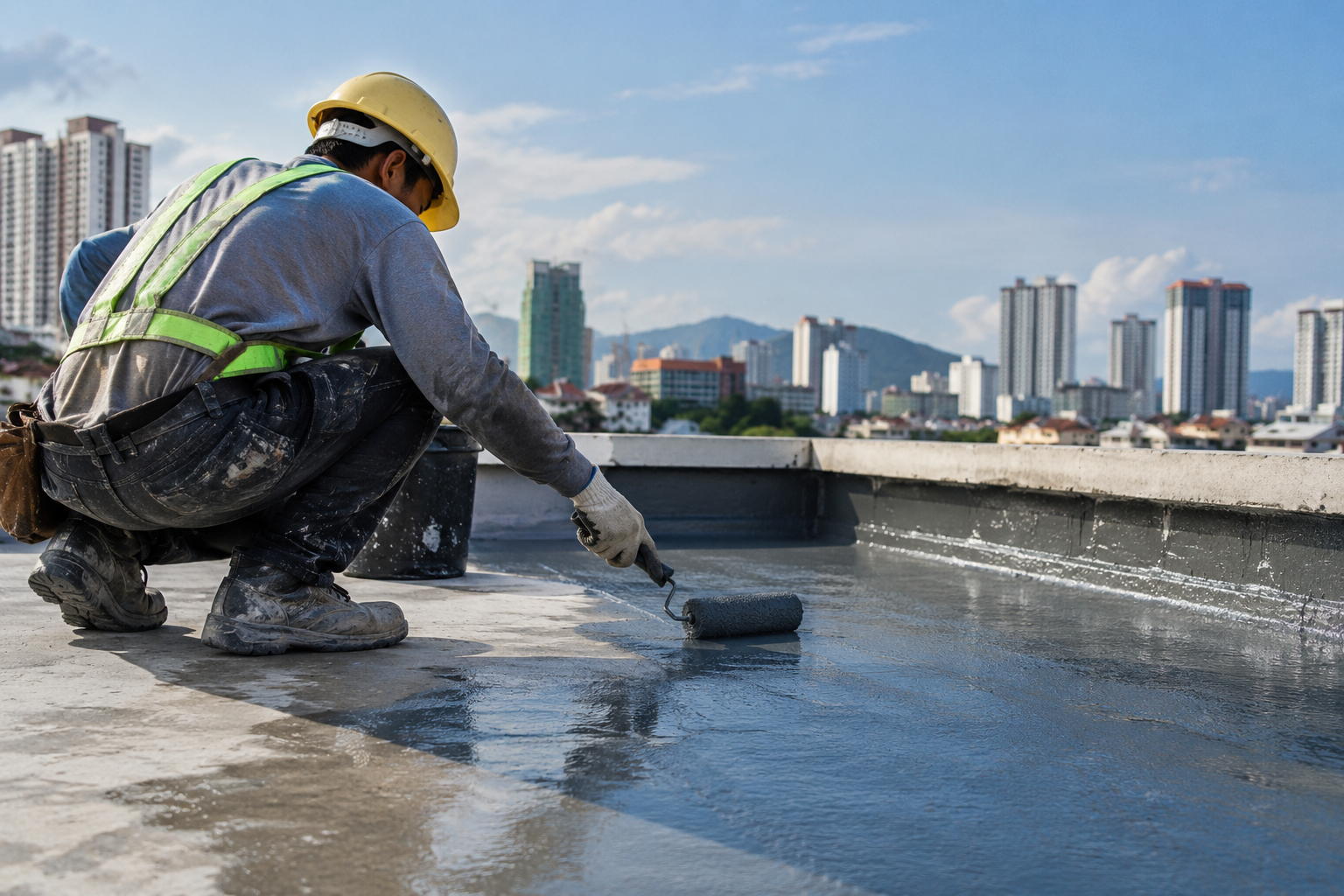
How to Choose a Waterproofing Contractor in Malaysia: 7 Key Checks
Hiring a waterproofing contractor in Malaysia starts with one question: can the contractor identify why water is entering the building before recommending a repair? A convincing quotation should connect the suspected leak source, substrate condition, proposed waterproofing system, preparation work, access requirements and warranty terms. A low price or a long warranty alone cannot establish that a repair will last.
This guide helps homeowners, condominium JMBs and MCs, facility managers and industrial property owners compare waterproofing contractors on practical evidence rather than sales claims.
Quick Checklist: What to Check Before Hiring
- Relevant experience: Ask for completed projects involving the same type of roof, façade, wet area or deck.
- Diagnosis: Require an explanation of the likely water-entry path and what remains uncertain.
- System suitability: Check the proposed materials against substrate, exposure, movement and intended use.
- Written scope: Confirm surface preparation, detailing, quantities, access, testing and exclusions.
- Safety: Review the access method and protections for workers, occupants and the public.
- Quality checks: Ask how work will be inspected before and after covering the membrane.
- Warranty: Read coverage, exclusions, maintenance conditions and the defect-reporting process.
1. Define the Leak Problem and the Area That Needs Protection
Start with where water appears, when it happens and what has already been repaired. A ceiling stain after heavy rain may be caused by a roof detail, an external wall joint or another entry point some distance away. A damp basement wall may require a different investigation from a leaking bathroom or a traffic-bearing car park deck.
Record photographs, dates, weather conditions, affected rooms, previous repairs and any operational restrictions. For a condominium, include access arrangements and resident notices. For a factory or warehouse, note production hours, traffic, chemical exposure and shutdown windows.
Important: A visible crack or stain is not necessarily the source of the leak. Waterproofing over the symptom without tracing the water path may leave the underlying defect unresolved.
2. Verify the Contractor’s Experience and Credentials
Ask for references from similar building types and verify the contractor’s current registration and relevant project qualifications where applicable. Malaysia’s Construction Industry Development Board (CIDB) explains contractor registration requirements for construction works; buyers should check the registration and scope relevant to their project rather than assume every contractor has the same qualifications. See the CIDB contractor registration guidance.
Request the proposed supervisor’s experience, product application training where relevant, subcontractor arrangements and photographs of completed details. A contractor who primarily handles residential bathrooms may not be the right choice for an occupied high-rise façade or an industrial deck.
Do not assume a business described as a ‘specialist’ is automatically better than a general contractor. Assess the actual team, methodology, references and accountability for the waterproofing package.
3. Expect a Site Inspection and a Defensible Diagnosis
A proper inspection should review the affected surface, adjacent areas, joints, drainage falls, penetrations, previous coatings and signs of trapped moisture. The contractor may recommend moisture measurements, controlled water testing or further opening-up work where appropriate. Infrared imaging can assist in some conditions but does not, by itself, prove the source of a leak.
Ask the contractor to distinguish between observed defects, probable causes and items requiring further investigation. For complex water ingress or suspected structural movement, an engineer or other suitably qualified professional may be needed before the repair scope is finalised.
4. Compare Waterproofing Systems by Application, Not Just Brand
No single membrane or coating is suitable for every location. Selection depends on whether the surface is exposed to sunlight, submerged, buried, subject to movement or carrying vehicles, as well as the manufacturer’s system requirements.
| System or method | Common applications | What to confirm |
|---|---|---|
| Liquid-applied waterproofing membrane | Some roofs, balconies and complex details | Substrate preparation, primer, specified film thickness, reinforcement at joints and weather conditions |
| Sheet or bituminous membrane | Selected roofs and below-ground assemblies | Lap joints, termination details, protection layers and suitability for exposure |
| Cementitious waterproofing system | Selected wet areas and concrete surfaces | Crack-bridging capability, water-pressure direction, substrate condition and compatible finishes |
| Joint sealing or injection repair | Specific leaking joints and cracks | Cause of movement, crack condition, injection material and whether broader waterproofing is still needed |
| Traffic-bearing waterproofing system | Selected balconies, car parks and exposed decks | Waterproofing function, abrasion resistance, slip resistance, movement and traffic loading |
Waterproofing and floor coating are not interchangeable. A standard epoxy floor coating may protect a floor against wear or selected chemicals without forming a specified waterproofing system. If the project involves a factory floor or warehouse, compare the intended function with our related article on floor coating in Malaysia.
5. Compare Written Quotations on the Same Scope
Two prices are not comparable if one includes crack treatment, membrane detailing and access equipment while the other includes only surface coating. Ask bidders to price the same inspected area and clarify assumptions.
| Quotation item | What a useful proposal should explain |
|---|---|
| Diagnosis and boundaries | Area to be treated, suspected cause and limits of investigation |
| Surface preparation | Cleaning, removal of failed material, drying and repairs before application |
| System specification | Product names, layers, primer, reinforcement and manufacturer application requirements |
| Critical details | Drains, upstands, penetrations, joints, corners and terminations |
| Access and protection | Scaffolding or rope access if required, protection of occupants and operating areas |
| Inspection and testing | Hold points, application records, relevant tests and handover evidence |
| Commercial terms | Timeline, exclusions, variations, payment stages and written warranty terms |
For JMBs, MCs and commercial building managers, ask how the contractor will phase the work and communicate with occupants. For industrial facilities, clarify whether curing periods, ventilation and area closures affect operations.
6. Review Safety and Site Management, Especially at Height
High-rise façade and roof work require a documented access and risk-control approach. Discuss scaffolding, mobile platforms or rope access as appropriate to the site, along with exclusion zones, falling-object controls, weather limitations and emergency arrangements. Malaysia’s Department of Occupational Safety and Health provides work-at-height guidance covering safe access, equipment selection, inspections and rescue planning.
Ask who supervises the site, who checks completed substrate preparation and membrane details, and how changes to the original scope will be approved. A realistic programme is more useful than a promise to finish quickly regardless of site conditions.
Where waterproofing is part of a larger façade maintenance programme, sequencing matters: crack treatment, waterproofing, surface preparation and repainting should be coordinated. Our guide to choosing a painting contractor for building longevity explains related considerations for exterior finishes.
7. Understand the Warranty, Handover and Maintenance Plan
Do not judge a waterproofing quotation by warranty length alone. Ask whether the warranty covers material defects, application workmanship or both; when it starts; how a defect is reported; who investigates; and what exclusions apply. Check whether ponding, movement, later drilling, third-party alterations or neglected drainage affect coverage.
Before handover, request relevant product information, records of completed areas, photographs of concealed details where available, inspection or test results specified in the contract and maintenance instructions. Periodic checks of drains, joints and exposed surfaces can help identify developing defects early.
Common Mistakes When Selecting a Waterproofing Contractor
- Choosing the lowest price without comparing preparation and detailing.
- Approving a membrane before the leak source is reasonably understood.
- Assuming a product brand alone guarantees performance.
- Confusing decorative or protective floor coating with a complete waterproofing assembly.
- Accepting verbal warranty promises without exclusions and claim procedures.
- Ignoring site access, weather, curing and occupant safety.
- Failing to document completed work before finishes cover critical details.
How LNL Integrated Construction Can Support Waterproofing Projects
Established in 2003, LNL Integrated Construction Sdn Bhd works in specialist painting, façade repair and related building surface treatments. Its service range includes waterproofing, surface preparation, façade maintenance, floor coatings and high-rise access work. This broader capability can be relevant where leaks are connected with ageing external finishes, façade joints or maintenance work across an occupied building.
For any proposed project, the appropriate repair system and scope should still be determined after a site assessment. Clients should confirm the applicable materials, access arrangements, programme and warranty in the written proposal. Learn more about LNL’s painting and building maintenance services.
Frequently Asked Questions
How do I choose a waterproofing contractor in Malaysia?
Compare relevant project experience, a site-specific leak diagnosis, proposed system specifications, written scope, safety arrangements, inspection methods and warranty terms. Ask for references from similar properties rather than relying on price alone.
Should a waterproofing contractor inspect the site before quoting?
For a leak investigation or substantial repair, a site inspection is usually important to assess the affected area and likely water-entry paths. Some concealed conditions may still require further investigation after work begins.
Is epoxy floor coating the same as waterproofing?
No. A general epoxy floor coating is not automatically a waterproofing membrane. The system must be specifically designed and specified for the required waterproofing performance and service conditions.
What should a waterproofing warranty include?
Check the coverage for materials and workmanship, the start date, exclusions, maintenance obligations, defect-reporting process and who is responsible for investigating and rectifying covered failures.
Can waterproofing work be carried out on occupied condominiums or commercial buildings?
Often yes, with a site-specific plan for access, work zones, occupant communication, noise or odour control, safety and curing time. The practical approach depends on the building and selected system.
Discuss Your Waterproofing Requirements with LNL
Whether you manage a condominium, commercial building, factory or residential property, LNL Integrated Construction can discuss the affected surfaces and the next steps for a site assessment. Share photographs, the location of the leak and any previous repair history to help the team understand your requirements.
Disclaimer Statement
We hope you found this article informative. Our content is intended for general informational purposes only and does not constitute advice or necessarily reflect the full range of services offered by LNL Integrated Construction Sdn. Bhd.
Readers are advised to consult with a qualified industry professional and contact our experts for recommendations specific to their individual project needs. While we strive for accuracy and completeness in our blog posts, we cannot guarantee they are error-free. LNL Integrated Construction Sdn. Bhd. assumes no responsibility for any errors or omissions.